
 English

Blog
Provide One-Stop Customized Services
WCH is dedicated to providing high-precision and high-quality
tempered glass customization services for home appliance manufacturers.


2026-08-13 17:48:41
A microwave door has glass because it allows users to see the food while the appliance is operating while helping maintain the protective structure of the door. However, Microwave Door Glass is not simply ordinary household glass. It is an engineered component designed for appliance applications, with requirements for strength, heat resistance, visibility, dimensional accuracy, and safe installation.
For appliance manufacturers, choosing the right Microwave Door Glass involves more than selecting a transparent panel. The glass type, thickness, dimensions, edge processing, printing, and overall door construction all need to match the microwave design.
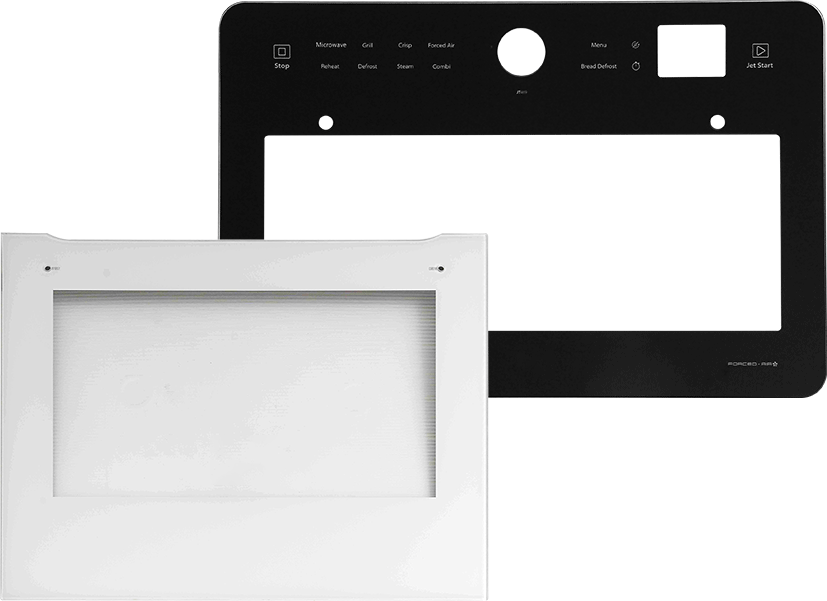
The glass in a microwave door serves several functions. First, it provides visibility so users can monitor food during cooking. Second, it forms part of the protective door assembly. Third, the glass must maintain its physical properties during repeated heating and cooling cycles.
Modern microwave doors can contain multiple components rather than a single flat piece of glass. Depending on the appliance design, manufacturers may use outer door glass, inner door glass, printed glass panels, and other door components as part of the complete assembly.
W.C.H. provides custom microwave glass solutions for microwave door glass, inner door glass, and control panel applications.
Tempered glass is commonly used in appliance applications because the tempering process improves the glass's strength compared with untreated glass. For microwave manufacturers, this can be important when the glass needs to withstand everyday handling, impacts, and temperature changes during normal appliance operation.
The exact glass specification should be determined according to the microwave design and manufacturer's requirements. Factors such as thickness, dimensions, processing, and installation method can affect the performance of the finished door.
Microwave door glass can be exposed to heat generated inside the appliance and to heat transferred from hot food and the surrounding door structure. For this reason, the glass needs to be suitable for the thermal conditions of the application.
Heat resistance is only one consideration. The complete door assembly, sealing structure, ventilation design, glass thickness, and other components also influence the temperature experienced by the door during operation.
For OEM projects, manufacturers should provide the expected operating conditions and current glass specifications so the glass supplier can evaluate the appropriate material and processing requirements.
A microwave can use different glass components in different positions of the door. Microwave door glass generally refers to glass used in the door assembly, while Microwave Inner Door Glass refers specifically to the glass component positioned toward the inside of the appliance.
| Feature | Microwave Door Glass | Microwave Inner Door Glass |
|---|---|---|
| Position | Part of the microwave door assembly | Located toward the inside of the door assembly |
| Main requirement | Visibility, strength, appearance, and dimensional accuracy | Suitable performance under the internal appliance environment |
| Customization | Size, shape, thickness, edges, and printing can be specified | Dimensions and processing depend on the microwave design |
These components should not be treated as interchangeable simply because they are both glass. The replacement or OEM specification should match the original appliance design.
Many microwave doors use printed areas around the glass rather than completely transparent panels. Printing can help create the visual design of the appliance and can also define borders or cover areas of the door structure.
For appliance manufacturers, the printing process should be considered together with glass type, surface treatment, heat exposure, dimensions, and appearance requirements.
When ordering custom printed Microwave Glass, provide the artwork, dimensions, printing area, color requirements, and technical drawing whenever available. This gives the glass manufacturer enough information to evaluate the project accurately.
For OEM and replacement projects, several specifications should be confirmed before ordering:
Glass type: Confirm whether tempered glass or another specified glass construction is required.
Thickness: Match the thickness to the original design and door assembly.
Dimensions: Provide accurate length, width, and dimensional tolerances.
Shape: Confirm whether the panel is rectangular or requires a customized shape.
Edge processing: Specify polished, rounded, or other required edge treatments.
Holes and cutouts: Provide exact locations and dimensions when required.
Printing: Supply artwork and confirm the required printed areas and colors.
Surface treatment: Confirm whether a coating or other surface treatment is required.
W.C.H. states that its microwave glass can be customized in size, shape, and thickness, with options including edge processing, holes, coatings, and other tailored requirements. :contentReference[oaicite:1]{index=1}
Custom microwave glass is particularly useful when an appliance manufacturer is developing a new microwave model, modifying an existing door design, or sourcing replacement components that are not available in standard dimensions.
Instead of adapting the appliance around a standard glass panel, OEM buyers can provide the required dimensions and technical specifications to the glass manufacturer. This approach is useful when the door requires irregular shapes, special thicknesses, holes, printed areas, or specific edge processing.
If you are developing a new microwave model, send the glass drawing, dimensions, thickness, printing requirements, expected quantity, and application details to the supplier for technical evaluation and quotation.
A qualified microwave glass manufacturer should be able to work from technical drawings and production requirements rather than only supplying standard glass panels.
Important capabilities include glass cutting, edge processing, tempering, printing, dimensional control, and customized production. W.C.H. specializes in tempered glass for electrical appliances and provides customized microwave glass solutions for appliance manufacturers. :contentReference[oaicite:2]{index=2}
For a new OEM project, discussing the complete specification with the manufacturer at the beginning can help reduce dimensional problems, unsuitable processing, and unnecessary sample revisions.
Microwave door glass is not simply a decorative component. Its dimensions and processing need to match the surrounding door structure. Even a small dimensional difference can create problems during assembly.
Accurate cutting, edge processing, thickness control, and customized shapes are therefore important for OEM production. W.C.H. specifically describes its microwave glass as customizable in size, shape, and thickness and highlights precise cuts and smooth edges for appliance applications. :contentReference[oaicite:3]{index=3}
The glass allows users to see the food while forming part of the microwave door structure. Microwave door glass is designed specifically for appliance applications rather than being selected as ordinary household glass.
Tempered glass is commonly used for microwave glass applications. The exact specification depends on the microwave design, including the required thickness, dimensions, processing, and door construction.
Yes. Custom microwave glass can be produced according to specific dimensions, shapes, thicknesses, edge requirements, holes, coatings, and printing requirements. :contentReference[oaicite:4]{index=4}
Yes. OEM buyers can provide drawings, dimensions, glass specifications, printing requirements, and estimated quantities to a microwave glass manufacturer for evaluation and quotation.
Provide the glass dimensions, thickness, shape, edge processing, holes or cutouts, printing requirements, coating requirements, quantity, and the microwave model or application. A technical drawing is recommended when available.
For custom microwave door glass, provide your drawing or specifications and the required quantity so the manufacturer can evaluate the glass structure, processing requirements, and quotation.

Tel/Whatsapp:+86 13423078888
E-mail:chloe_mo@wchtemperglass.com
Address:Yuan He Road North, Xiang Xi Industrial Zone, Shipai Town, Dongguan City, Guangdong Province, China


Privacy Policy Cookie Policy Terms and Conditions
Copyright © 2025 W.C.H Temper Glass Co., Ltd. All rights reserved.